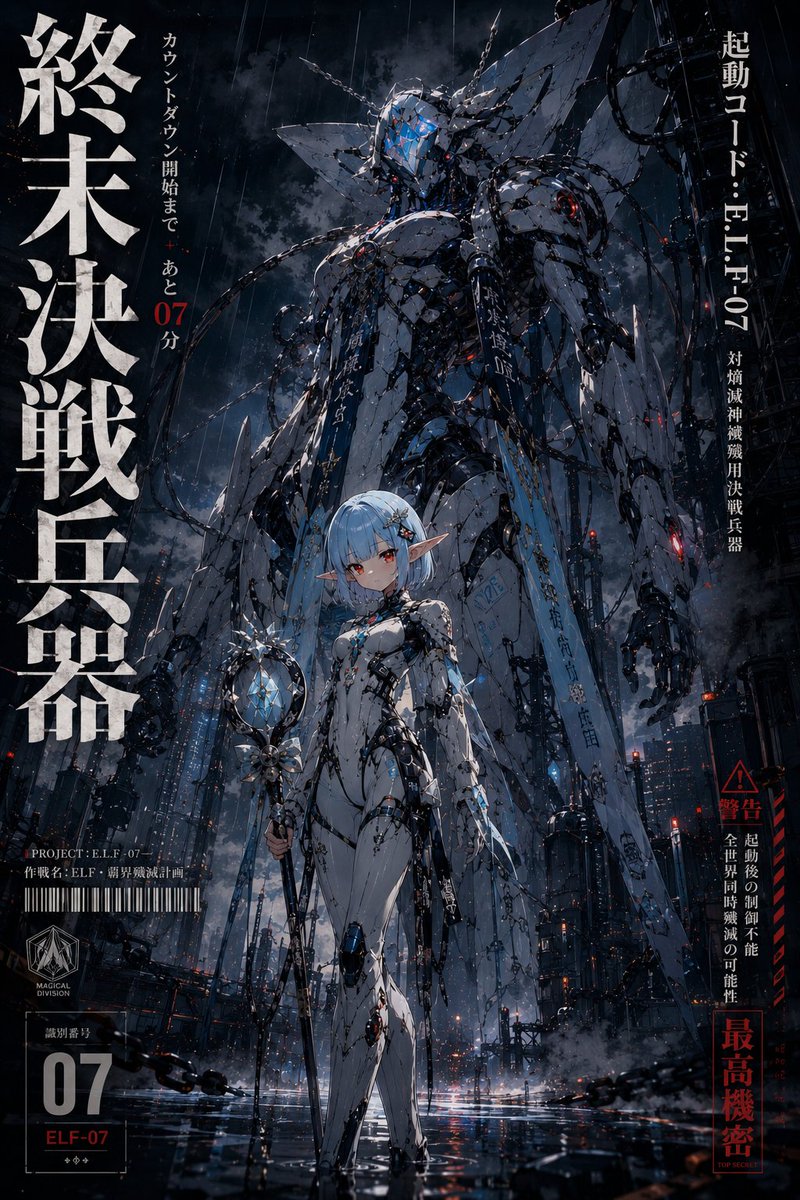
GPT i2i prompt:
Using the reference image character as a base,
create an illustration that resembles
"a theatrical key visual for a non-existent legendary robot anime."

Channel the atmosphere of 1990s-2000s Japanese anime:
apocalyptic warfare,
colossal decisive battle weapons,
bio-weapons,
sealed weapons,
theatrical anime poster ambiance.

Emphasize the overwhelming scale contrast between giant weapons and characters,
ultra-bold Mincho-style typography,
end-of-the-world sensation,
industrial backgrounds,
the feeling of "right before the final decisive battle."

Use the reference image as the character design base.

Maintain with high fidelity:
the character's face,
hairstyle,
hair color,
eyes,
facial contours,
silhouette,
head-to-body ratio,
costume design,
and overall impression.

Do not break the character's identity.
Do not redraw as a different character.

The character wears a form-fitting near-future pilot suit designed for decisive battle weapons.

The pilot suit should be reconstructed based on the reference image's character design.

Reflect into the suit design naturally:
hair color,
eye color,
accessories,
costume motifs,
silhouette elements.

Do not make it just a generic existing sci-fi suit.

Make it feel like "decisive battle equipment made specifically for this character."

The character should not be a static, straight-on pose,
but rather a natural, emotionally expressive pose
befitting a theatrical anime key visual.

Give each generation a different body angle,
center of gravity,
line of sight,
and arm placement.

Allow the following pose variations—static but visually strong:
- A quiet posture conveying pre-battle tension
- Looking back over the shoulder toward the viewer
- Side profile gazing upward at a distant giant weapon
- One arm crossed
- Both arms lightly folded
- One hand resting at the neck or shoulder
- One hand on the hip
- A languid, fatigue-tinged stance
- A natural standing pose with weight shifted to one leg

The pose should channel the atmosphere of:
fashion photography,
1990s anime posters,
movie posters,
character-driven standing poses.

Do not make it a "standing-straight reference sheet."

Apply natural asymmetry to:
body angle,
shoulder line,
pelvic tilt,
gaze direction.

Do not place the character symmetrically at the center of the frame.

The character's stance should feature:
silhouette-conscious, natural body acting,
like a fashion magazine cover.

Make it a frozen moment—as if captured mid-motion—
not a static pose.

Do not lock the gaze to camera.
Allow the gaze to escape toward:
the distance,
the ground,
giant weapons,
warning displays,
the sky.

In the background,
a colossal humanoid decisive battle weapon designed specifically for this character exists.

Important:

Do not directly imitate robots from existing works.

However, draw from the design language of 1990s-2000s...