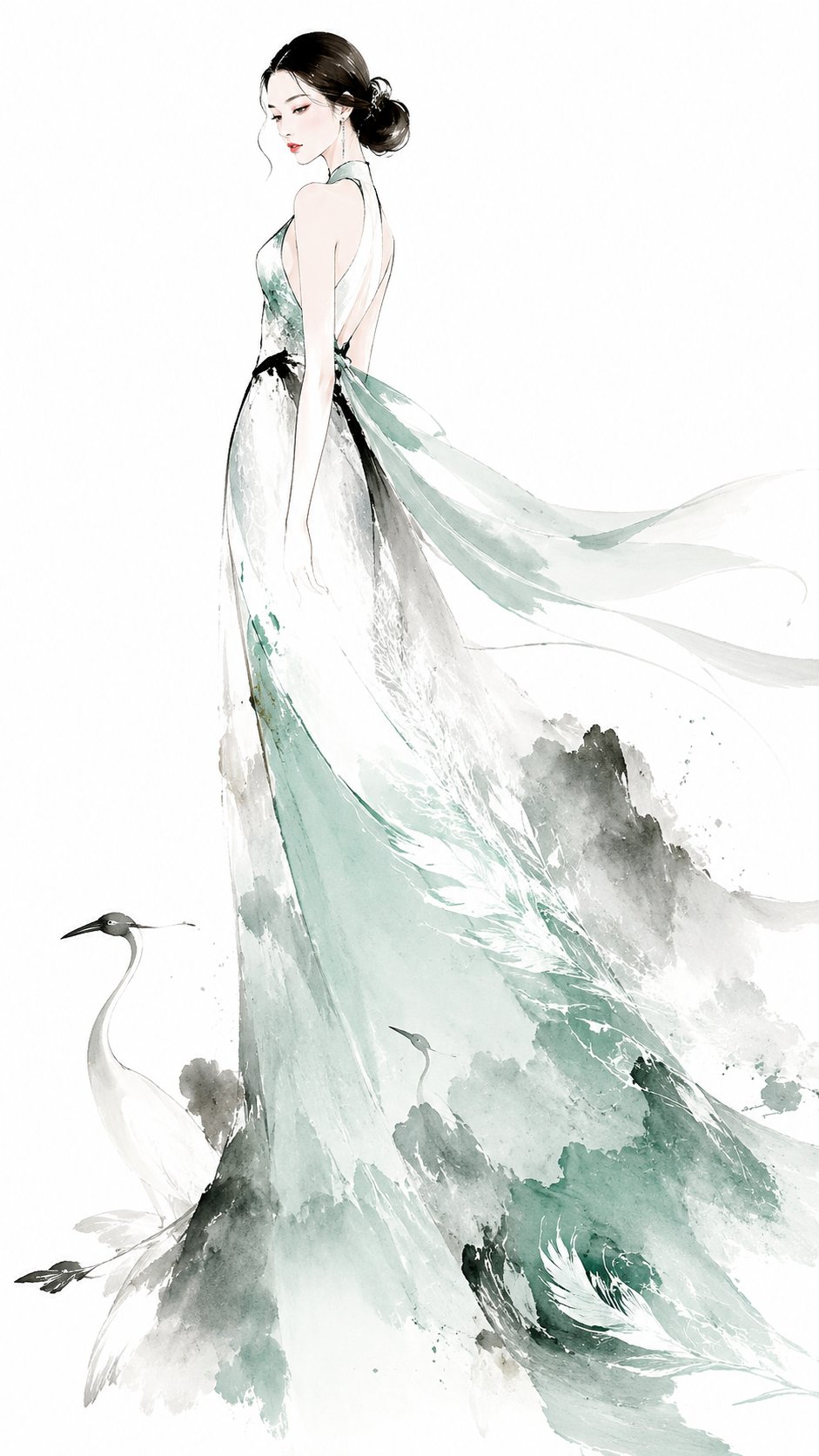
Generate a fully original "Inkline Couture (墨线霓裳)" series Oriental fashion illustration, in 9:16 vertical format.
Overall style blends: modern Oriental haute couture, Chinese ink-wash aesthetics, light watercolor texture, delicate calligraphic linework, and refined large areas of negative space. The image should feel poetic, light-luxury, ethereal, elegant, exquisite, and rewarding to look at.
The background should not be a hard pure-white base, but a very light warm-white, off-white or rice-paper white, with extremely subtle rice-paper texture, faint paper grain, barely-there mist, ink-wash atmosphere layers and slight light-dark gradation. Achieve "white but not empty," keep ample breathing room, but never look crowded, messy or over-filled.
The subject is an elegant, slender Oriental woman, slim build, composed posture, calm expression, with the air of high-fashion illustration. She should be like a modern Oriental couture muse, not an ordinary ancient-style beauty, nor a realistic influencer photo. Her face should be refined and clean, delicate features, restrained makeup, soft gaze, with a cool, reserved, elegant temperament. The hairstyle should be natural and refined, e.g. low bun, structured updo, half-up, or flowing styled strands, with a few naturally loose strands.
The garment design should be an original neo-Chinese couture gown, modern Oriental long dress, or qipao-inspired high fashion. The overall silhouette is slender, light, flowing and design-driven. The garment may include: semi-transparent gauze layers, light water-sleeves, ribbons, trains, waist structure, refined collars, asymmetrical couture cuts, etc. The clothing must not look like a cheap costume — it must look like an Oriental gown in high-fashion illustration.
Let the garment, sleeve hems, ribbons, skirt hems or train gradually merge into poetic ink-wash imagery, e.g.: cranes, feathers, clouds, moon halos, water ripples, flower shadows, ink petals, ribbons, mountain mist, wind traces. These images should grow naturally within the garment and atmosphere, not be hard-pasted decoration.
Lines should be thin, light, refined. The subject outline uses ink lines with brush-calligraphy feel, with slight thickness variation, finishing strokes, flying-white and elegant flow, but not heavy, not thick-black, not messy. Local details may add extremely fine gold lines, light silver lines, hem outlines, feather veins, petal textures, fine water ripples, slight embroidered hidden patterns, internal fold lines, transparent gauze layering — so close-up shows fine craftsmanship while the whole stays restrained.
The ink-wash parts should be both free and controlled. Ink tones should have layers: one or two slightly darker heavy-ink areas as visual focus, diffusing outward, combined with light ink, water marks, flying-white edges and interspersed negative space. Do not let the ink become dirty, messy, over-splashed or chaotically spreading.
For color, use low-saturation, Oriental, refined palettes, e.g.: celadon green, jade white, moon white, light gray-blue, warm ivory white, low-saturation cinnabar red, ink black, deep indigo, soft gray, restrained light gold. Color transitions should be soft, natural from dark to light. Accent colors should be used sparingly, only in small areas on lips, earrings, ribbons, hems, moonlight, water ripples, petal lines or local gilding.
Composition should stay vertical, transparent, well-spaced, with fashion-poster feel. The figure may stand, sit, glance back, turn, dance, or stand still, but keep enough breathing space. The whole image should be like a high-end Oriental fashion visual poster, not an ordinary decorative illustration.
Final temperament keywords: refined, poetic, modern, elegant, light, restrained, Oriental, light-luxury, artistic. The whole image should have both fine craftsmanship and ink-wash spirit.