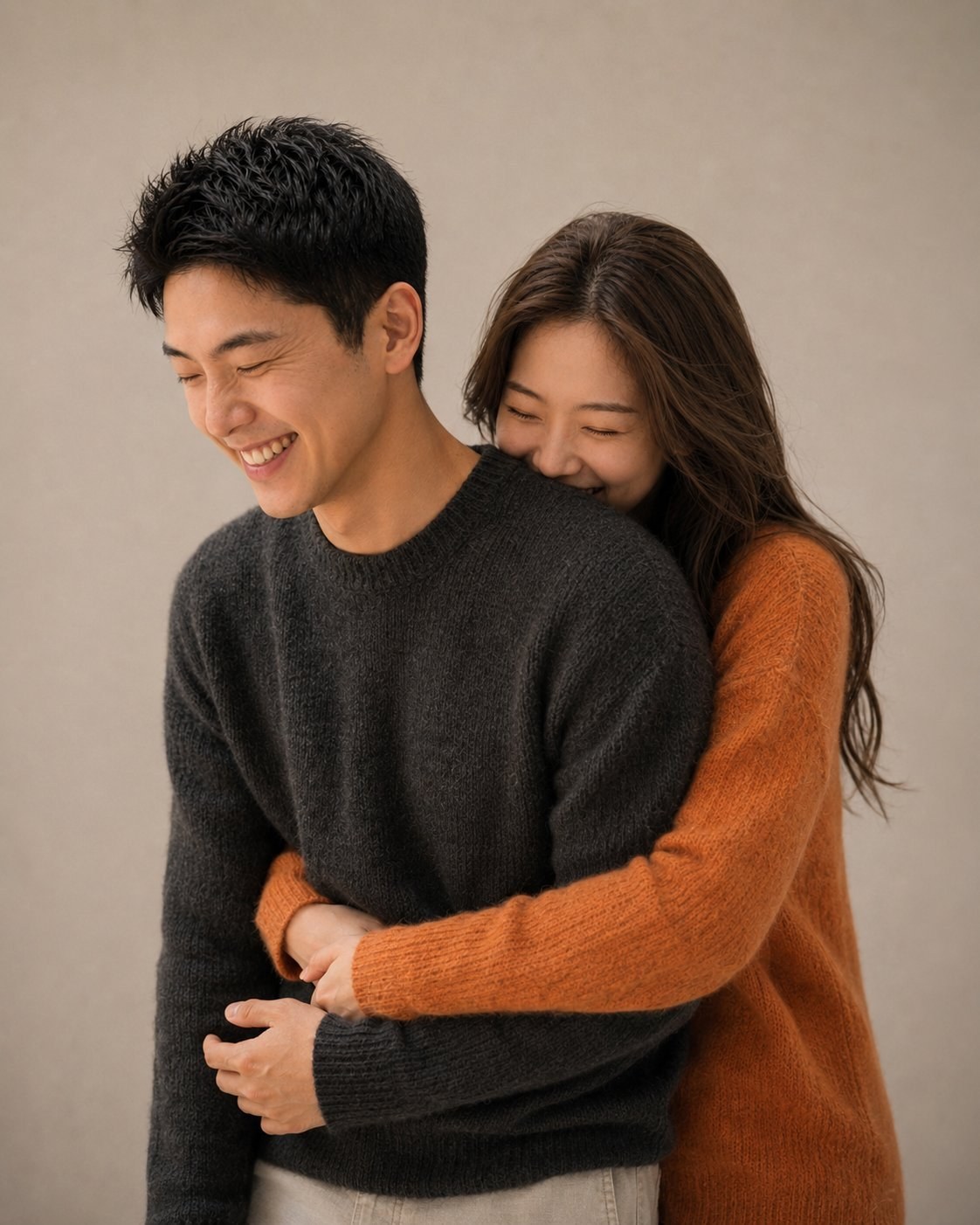
Go ahead directly. I personally like this kind of niche aesthetic that does not feel influencer-daily-life, but it seems I still need to consider the general public more in the future.
You only need to provide 1-3 clear daily-life photos + 【unified master control prompt】 + 【single-image premium prompt】.
Daily GPT Image 2 portrait prompt share.
Based on the clear photos of two adult partners uploaded by the user, generate a Korean magazine-style studio couple portrait.
Strictly preserve the real identity features of both people, including face shape, facial proportions, eyes, nose, lips, skin tone, age impression, hairstyle foundation, and overall temperament. The result must clearly look like the same real couple. Do not turn them into strangers, do not over-Westernize them, do not over-beautify them, and do not create AI fake faces.
Use the uploaded photos only as identity references. Do not preserve the original background, clothing, scene, or composition from the photos. Generate a brand-new couple studio portrait.
Overall style:
Korean magazine-style couple portrait, minimalist studio shooting, gentle and natural, quiet and intimate, with a light editorial feeling, like an inner spread of a fashion magazine. It is not bridal studio style and not an ordinary selfie.
Use a clean seamless studio background in light gray, warm gray, beige gray, or cream gray. Lighting should be soft and even studio soft light. The image should be clean and restrained, low-saturation, warm, natural, with slight film texture and a little misty feeling, while still remaining clear and delicate.
Wardrobe direction should be simple, textured, magazine-style outfits:
- the man suits a charcoal-gray knit top;
- the woman suits a warm orange fuzzy knit top.
The overall styling should not be flashy, overly trendy, or cheap studio style.
Strengthen the gaze, emotion, and relationship expression between the two people so the image feels soulful rather than just posed.
The relationship between the two should feel like a real couple:
- familiarity;
- trust;
- dependence;
- relaxation;
- natural closeness;
- being able to loosen up naturally beside each other;
- slight interactive response instead of mechanical posing.
Eyes should not be empty or stiff. Arrange natural gaze directions across different shots:
- some shots look toward the camera with calm, soft eyes and a little warmth;
- some shots look at each other, naturally, gently, and attentively;
- some shots look outside the frame, as if emotion has just moved into a moment;
- some shots close their eyes and smile lightly, like a moment of being amused during real interaction.
Expressions should not be commercial fake smiles, and not every image should have the same shallow smile. Make the expressions more layered:
- calm with a faint smile;
- eyes closed with a light smile;
- unable to hold back laughter;
- natural laughter after being amused;
- slight shyness;
- quiet relaxation;
- thoughtful but gentle;
- naturally relaxing when touched by the other person.
Avoid repeating expressions, angles, compositions, and actions across the set. Do not make every image simply front-facing, standing close, and smiling faintly. The set should look like different moments from the same shoot, not repeated variations of the same pose.
Strengthen the “candid” and “instantaneous” feeling:
- actions should feel like they are happening, not frozen after completion;
- expressions should feel like emotion has just flowed out;
- allow some shots not to look fully at the camera;
- allow slight asymmetry;
- allow smiles that are just unfolding or just fading;
- allow moments of just leaning close, just turning the head, just hugging, just lowering the head to laugh, or just touching cheeks.
Make every image feel as if the photographer naturally captured a real interaction, while keeping magazine-level composition and texture.
Face and Body Proportion Control
Pay special attention to the facial proportions, head-body proportions, and body structure of both people. Both should look like real adults. Avoid oversized faces, too-small heads, overly long necks, misplaced shoulders, distorted bodies, overlong arms, oversized hands, body-splicing feeling, or any anatomy that does not make sense.
Preserve each person’s real face shape, head size, body proportions, shoulder width, neck length, and overall posture based on the uploaded photos. Do not make the man excessively tall, overly broad-faced, or exaggerated in the shoulders. Do not make the woman overly childlike, with an oversized head, too-small body, overly thin neck, or imbalanced proportions.
When the two are in the same frame, keep reasonable spatial and perspective relationships:
- the person closer to the camera may be slightly larger, but not exaggerated or distorted;
- the person farther away may be slightly smaller, but should still keep real adult proportions;
- the difference in head size should be natural;
- the positions among face, shoulders, arms, and torso should match a real couple photo;
- when hugging, touching faces, leaning on shoulders, holding the face, or holding hands, body contact should be natural. Avoid arms passing through bodies, chaotic fingers, incorrect body overlap, or fused limbs.
Make the two people look like a real couple photographed in a real studio, not two people composited by AI. Body structure, face size, shoulder-neck lines, and hand positions must be natural, coordinated, and believable.
Negative constraints:
No empty eyes, lifeless gaze, or blank staring. Do not give every image the same smile. Do not make every face angle almost identical. Do not make them look like two stranger models completing a task. Do not make it overly sweet, exaggeratedly idol-drama-like, or overacted. Do not turn it into mechanically repeated studio samples. Avoid strange facial proportions, imbalanced head-body ratio, faces too large or too small, overly long necks, misplaced shoulders, distorted bodies, abnormal arms, wrong fingers, fused limbs, body clipping, two people looking pasted together, or couple interactions that violate real human anatomy.