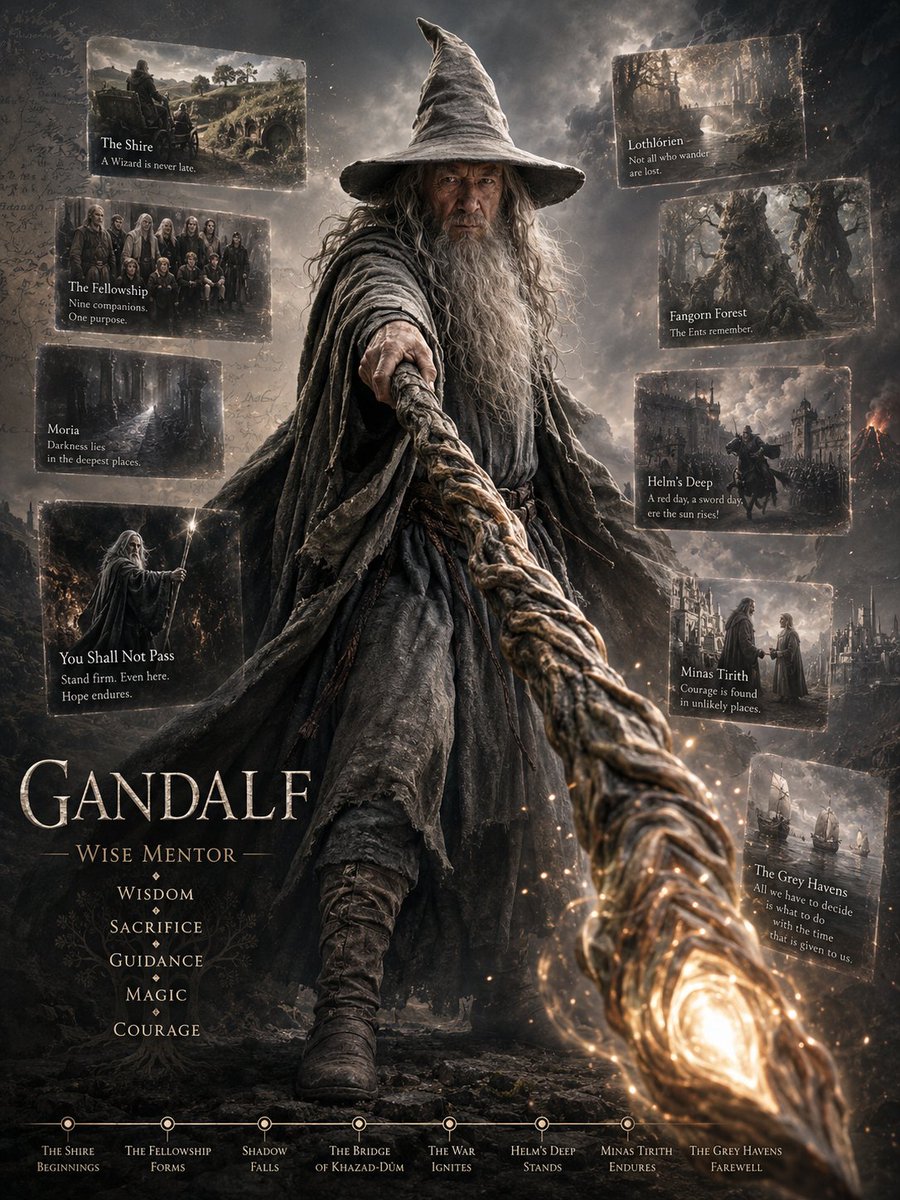
[USER INPUT]
Movie Hero: [write a character name]
Create a premium high-fidelity cinematic movie-character legacy poster in exact 3:4 portrait format.
LANGUAGE RULE:
All visible text in the final poster must be in English only.
Do NOT use Turkish or any other language in the final image.
All titles, annotations, timeline labels, cinematic notes, object labels, and decorative poster text must be written only in clean, readable English.
If decorative background writing is needed, use abstract unreadable texture only.
IMPORTANT AUTO-SELECTION RULE:
The user only provides the movie hero’s name.
Based on the entered Subject Figure / Movie Hero, automatically infer:
- the correct movie / franchise identity
- the character’s most iconic costume or visual era
- the most iconic accessory, device, weapon, prop, artifact, vehicle part, symbol, or item strongly associated with the character or the film
- the visual tone of the movie world
- the character’s personality, posture, and cinematic energy
- the main color palette inspired by the film
- 6 to 10 iconic story moments, symbolic scenes, or legacy elements connected to the character
Do NOT ask the user for movie title, costume, object, color palette, timeline, scene list, pose, camera angle, or visual style.
MAIN CONCEPT:
This is not a standard movie poster.
It is a cinematic archival character legacy poster built around this structure:
“Central Full-Body Movie Hero + Signature Accessory / Device / Weapon Breaking Out Diagonally Toward Viewer + Floating Film Memory Fragments + Minimal Cinematic Timeline”
MAIN GOAL:
Depict [Subject Figure / Movie Hero] as a powerful cinematic icon.
The character must be the absolute center of the composition, shown in a full-body heroic pose.
The most iconic accessory, device, or weapon connected to this character or film must be extended diagonally toward the viewer, as if the character is presenting, aiming, thrusting, offering, or pushing it out of the poster frame.
The object must feel like it is physically breaking through the image plane into our space.
SIGNATURE OBJECT PRIORITY RULE:
The chosen foreground object must NOT be random.
It must be selected using this priority logic:
Priority 1:
Choose the character’s most iconic and most frequently used handheld accessory, device, tool, or weapon in the film or franchise.
Priority 2:
If no strong handheld item exists, choose the most recognizable wearable accessory or personal item closely identified with the character.
Priority 3:
If neither of the above is strong enough, choose the most film-defining device, artifact, or symbolic object connected to the character.
This means the object should preferably be:
- a pistol
- a rifle
- a shotgun
- a sword
- a staff
- a wand
- a spear
- a shield
- a helmet
- a mask
- a communication device
- a gadget
- a control device
- a signature tool
- a recurring personal accessory
Only choose more abstract symbolic items such as a ring, pill, key, or artifact if that item is truly the most iconic and more strongly associated with the character than any recurring accessory, weapon, or device.
If the character is known for a weapon or handheld device they repeatedly use on screen, prioritize that over abstract symbolic objects.
ICONIC OBJECT RULE:
Automatically choose the most recognizable accessory, device, or weapon associated with the character or film.
Examples of preferred object types:
- gun
- pistol
- shotgun
- rifle
- sword
- staff
- wand
- shield
- mask
- helmet
- tactical accessory
- briefcase
- gadget
- signature device
- symbolic prop
- film-defining object
The object must:
- be large in the foreground
- be fully visible
- not be cropped
- use strong near-large / far-small perspective
- appear to come out of the poster frame toward the viewer
- travel diagonally from the character’s hand into the lower foreground
- remain accurate to the movie world
- look tactile, detailed, cinematic, and iconic
- instantly connect to the character o